Wondering how much propane is actually in your tank? You might think a full tank equals the total capacity, but safety rules mean you’re only getting about 80% of that.
For example, a 20-pound grill tank holds roughly 4.6 gallons in total, but you only have around 3.8 usable gallons.
Keep reading for a clear breakdown of how much propane you really get based on tank size.
Quick Answer: Usable Propane Gallons by Tank Size
The usable propane amount depends on the tank size and is calculated at an 80% fill level for safety and accuracy. For example, a 20 lb cylinder provides about 3.8 usable gallons of propane. A 30 lb tank offers roughly 7 gallons, and a 40 lb tank contains about 9 gallons. Larger tanks scale up accordingly; a 100 lb cylinder holds approximately 23 gallons, while a 120-gallon tank provides around 96 gallons. For a reliable comparison, consider checking reviews on battery charger quality for related equipment. When camping, a portable generator can run efficiently on a 20 lb tank for several days of moderate use. For optimal generator performance, pairing the tank with an inverter that has clean power output ensures steady operation of sensitive electronics.
For residential heating tanks, a 250-gallon tank offers about 200 usable gallons, a 500-gallon tank supplies roughly 400 gallons, and a 1,000-gallon tank provides around 800 gallons. Always base your calculations on 80% of the tank’s total capacity to ensure safe and reliable use. This approach helps prevent surprises and ensures you have enough propane for your needs without risking safety.
Why Tanks Are Only Filled to 80% (It’s Not Just a Rule)
Your propane tank is only filled to 80% of its capacity to serve as a safety buffer. That remaining 20% empty space is crucial because propane expands significantly with temperature changes. On hot days, the liquid inside the tank heats up and expands, sometimes more than water would. Without enough vapor space, the increased pressure can cause the tank to overfill, forcing propane out through the relief valve. This overflow risk creates serious fire and leak hazards. The 80% fill limit ensures there is enough headroom to accommodate thermal expansion, preventing dangerous pressure buildup. Overfill prevention devices help enforce this limit, making sure you cannot accidentally overfill the tank even if you try. This safety measure reduces the risk of high-pressure failures, keeps your system operating safely, and prevents unsafe venting—all without sacrificing enough propane for proper use. A similar principle of thermal expansion applies when considering a solar charger for maintaining your car battery in extreme temperatures. Following the same logic, you must let propane tanks cool before connecting them to a trickle charger for any related maintenance tasks. Understanding how a power inverter converts stored DC power into usable AC power can help you safely manage battery systems during temperature fluctuations.

Compatible with all appliances featuring a QCC1 / Type 1 connection, this gauge is suitable for propane tanks ranging from 5 lb to 40 lb. Note: This product is not suitable for propane tanks exceeding 40 lb

Replacement OPD valve for a standard steel 30LB propane cylinder
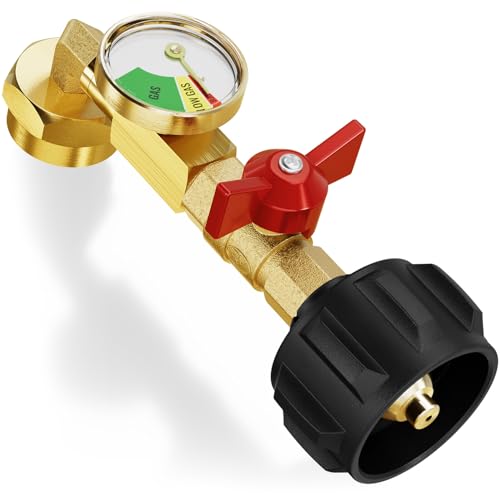
Effortless Refilling - The 90-degree elbow design facilitates smooth gas flow to smaller cylinders, allowing for easy attachment to large tanks and 16oz tanks, enabling refills in just one minute.
How to Read Your Propane Tank Gauge (Not Gallons)
Since your propane tank gauge measures percentage and not gallons, the needle indicates how full the tank is rather than a specific volume. You’ll find the circular dial beneath the protective dome on top of the tank. The needle points to a number between 5 and 95, representing the percent of usable capacity remaining. An 80% reading signifies the tank is nearly full, while a 30% reading suggests you should schedule a refill soon to avoid running out. For homeowners who store a backup generator in a dedicated structure, understanding propane tank levels is critical to ensure reliable generator operation during an outage. Using the right 10W-30 oil helps maintain generator engine performance under varying loads. Those relying on backup power for medical devices such as a CPAP machine should also consider battery backup options for uninterrupted sleep.
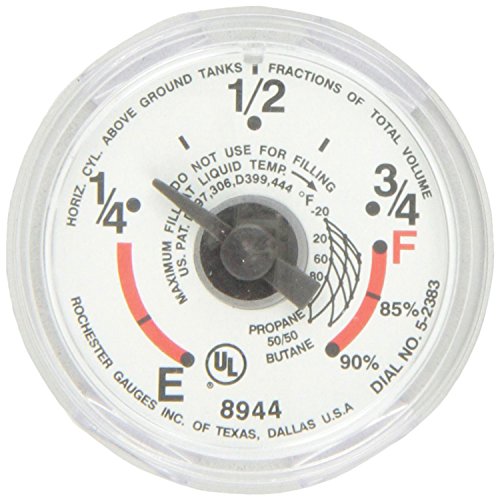
Direct reading dial for tanks

Set of 2. Compatible with all appliances with a QCC1 / type1 connection and up 5 lb to 40 lb propane tanks.
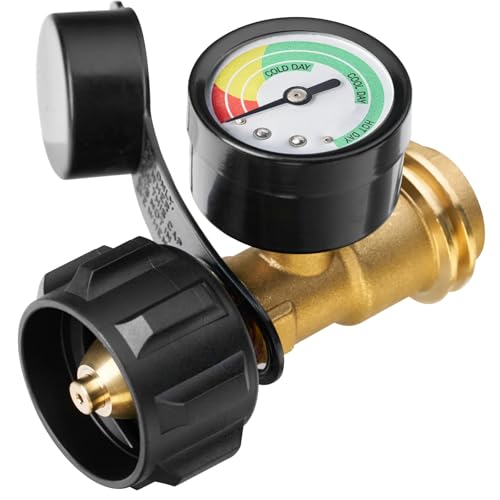
WIDELY SUITED - Compatible with all appliances with a QCC1 / type1 connection and 5 lb to 40 lb propane tanks, and can be worked with propane tank cylinders, propane regulator with hose and propane adapter
Propane in 20 Lb, 30 Lb, and 100 Lb Cylinders
A propane cylinder’s “lb” rating directly indicates its propane weight, not the weight of the tank itself. A 20 lb cylinder contains about 4.6 to 4.7 gallons of liquid propane, making it well-suited for portable grilling, such as BBQs. Upgrading to a 30 lb cylinder adds roughly 2.1 to 2.5 gallons, totaling around 6.8 to 7.1 gallons, which is ideal for longer cookouts or RV use. For larger capacity needs, a 100 lb cylinder holds approximately 23.6 gallons of propane—about five times the capacity of a 20 lb tank. Always handle these tanks safely by keeping cylinders upright and away from heat sources, and remember that propane weight is measured in pounds, while volume in gallons. To determine an exact remaining amount, you should check the tank’s tare weight stamped on the collar to calculate the propane weight. Understanding this measurement is similar to how a battery load tester verifies a battery’s actual condition rather than just its surface charge. When choosing a tank, reviewing reviews on top propane tanks can help ensure you select a model built for quality and performance.

NEVER RUN OUT OF PROPANE: Our built-in gas meter gauge provides accurate gas level readings so you don’t have to worry about running out of propane!

High-grade steel-welded construction; premium OPD (overfilling protection device) valve assembly
High-grade steel-welded construction; premium OPD (overfilling protection device) valve assembly
What Percentages Mean on 500 and 1000 Gallon Tanks?
When reading a gauge on a 500 or 1000 gallon propane tank, the percentage indicates how much propane remains relative to the tank’s total capacity. For a 500-gallon tank, 80% means approximately 400 gallons, and 70% equals about 350 gallons. For a 1000-gallon tank, 80% is roughly 800 gallons, and 70% is about 700 gallons. Always keep in mind that propane tanks are typically filled to no more than 80% capacity to allow for vapor expansion and safety. A 40% reading suggests you’re approaching a good refill point, while 30% indicates it’s time to schedule a delivery. Falling below 20% is urgent, and at 10%, you risk running out of supply. For maintenance, never let the tank drop below 5%, as this helps prevent an unexpected run-out. To estimate how much propane remains, simply multiply the tank’s total capacity by the percentage indicated on the gauge. Routinely checking the gauge and monitoring for voltage drop warning signs can help identify battery system issues before a critical failure occurs.
Convert Propane Pounds to Gallons Quickly
To convert pounds of propane to gallons, divide the net propane weight in pounds by 4.2. First, weigh your tank and subtract the tare weight stamped on the collar to find the actual propane weight. For example, a full 20-pound tank contains approximately 4.7 gallons (20 divided by 4.2). For more accuracy, especially in warmer weather when propane expands, use a divisor of 4.23 or 4.24. Always handle propane carefully—never use open flames or smoke during weighing. To ensure the task is done safely, treat any electrical connections used near the tank with the same caution as connecting a battery tender. Regular tank maintenance, such as checking for rust and ensuring valves are tight, helps prevent leaks. Remember, this calculation is only valid for liquid propane, not vapor. A 100-pound tank typically holds about 23.6 gallons when full. Knowing how many gallons a tank holds helps you estimate generator runtime based on your generator’s fuel consumption rate. You should also watch for warning signs like rust, dents, or valve damage to decide when replacement beats repair.
Propane Tank Size for Home or Grill?
The ideal propane tank size for your needs depends on how frequently and for what purposes you’ll use it. For a standard gas grill, a 20-pound tank is common; it holds about 4.6 gallons of propane and provides enough fuel for several weekend barbecues. If you require longer runtime or plan to power larger grills or outdoor heaters, consider a 30-pound tank, which offers approximately 7.1 gallons. For home heating or multiple appliances, tanks ranging from 100 to 500 gallons are suitable. A 100-gallon tank can support small residential heating needs, while 250- to 500-gallon tanks are designed for whole-home heating systems. When choosing, factor in space availability, refueling frequency, and safety, ensuring tanks are stored upright and away from ignition sources. Keep in mind that larger tanks decrease refill frequency and delivery emissions, providing a more convenient and eco-friendly fuel option for extensive use.

Convert your connection - for the moments you feel that a 16. 4oz propane tank just isn’t enough, gas one’s 1 to 20 lb. Propane Converter (4Ft) allows for 1lb propane adapters to be used for 20lb propane tanks!

Updated Propane Hose Adapter — Alloxity propane hose adapter is specifically designed to fit perfectly for Weber Q grills, Coleman camping stoves, Blackstone 17" & 22" griddles (regulator needed) and Buddy heaters. Moreover, this propane adapter hose can easily connect most 1lb. LP outdoor appliances to 5-40lb propane tanks, making it an ideal choice for camping, tailgating, heating or outdoor grilling.
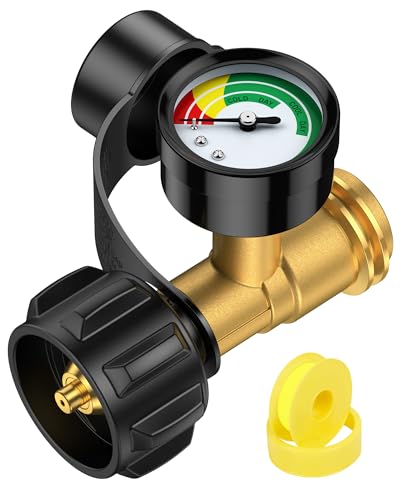
COLORED & RELIABLE GAS MONITOR – Colored reading allows you to check the gas level at a glance. Needle in green area means sufficient gas, yellow means low gas, and red means nearly empty gas. Through detecting air pressure, the propane tank gauge measures remaining capacity of propane. This propane gauge can also work as LEAK DETECTOR.
Estimate Propane Tank Gallons Without a Gauge
If you don’t have a gauge, you can estimate how many gallons remain by knowing your tank’s size and doing some simple calculations. First, identify the rated size of your tank—such as 250 gallons—and remember that only about 80% of that is usable when full to prevent overfilling. To estimate the remaining volume, multiply the tank’s size by the percentage you think it’s filled, then multiply that result by 0.80. For example, if you estimate your tank is half full, multiply 250 gallons by 0.50, then by 0.80, giving roughly 100 gallons of remaining usable propane. It is similar to the logic behind safety rules for surge protectors, where following specific guidelines prevents hazards like overloading circuits. You can also weigh a smaller cylinder if you have one: subtract the tare weight stamped on the tank from the total weight, and then divide that by 4.24 pounds, the approximate weight of one gallon of propane. Knowing the full propane tank weight is essential for this calculation because it helps confirm the maximum usable fuel before subtracting tare weight. Keep in mind that external factors like temperature and placement influence accuracy—cold weather reduces pressure, which can make gauges and weight estimates less reliable, while a sheltered spot may slow burn rates. When using such estimation methods, ensure you follow safe operating tips to prevent accidents and battery or starter damage. These methods provide a rough idea of your propane level but should not replace precise measurements for critical planning.

Package Contents: you will receive 2 pieces of gas level indicators, the sufficient quantity and simple designs can satisfy your various decorating needs, which has a color scale that changes according to gas level

Important Fittings Check —— RV Propane Hose's Fitting: 1/4" Male NPT ( Not 5/16" Inverted Flare) & QCC Type 1. Length: 15 inch. (Tips: Please check the Fitting and Length carefully before ordering the rv gas hose.)

【Accurate Gas Level Indicator】You will receive 4 pieces of gas level indicator for meeting different requirements in practical use and every single one is well packaged. The gas level indicator can test the butane gas and propane gas quickly and accurately. Never run out of gas again!
Common Mistakes That Throw Off Your Propane Calculation
Even with a good estimate of your propane tank’s gallons, several common mistakes can still skew your calculations. First, many rely on the total tank capacity instead of the usable gallons. For example, a 500-gallon tank typically only has about 400 gallons available for use because the remaining space is reserved for safety and vaporization. This mistake can overstate your supply by as much as 25%, leading to unexpected shortages. Similarly, oil capacity mistakes in other equipment, like a generator, can also lead to incorrect fuel estimates.
Second, avoid using annual average consumption figures. Peak demand during winter months can drain your tank much faster than these averages suggest. It’s important to account for seasonal fluctuations to prevent misjudging your remaining propane.
Third, always consider appliance efficiency and actual usage times rather than just the appliance’s rated load. A high-efficiency heater might use less propane than a standard one under the same conditions, affecting your total estimate.
Lastly, be cautious with unit conversions. Mixing units, such as pounds and gallons, or skipping the necessary conversions for small cylinders, can create major volume errors. Additionally, cold weather limits vaporization, and site constraints from installation codes can restrict propane delivery and availability. Recognizing these factors ensures your propane calculations remain accurate and reliable.