Ever wonder how you can run your home electronics off a battery or solar panel? A power inverter is the key—converting DC power into the AC electricity your devices need.
It switches current quickly to mimic a standard wall outlet, though some energy is lost as heat. Choosing the right inverter makes a big difference in performance and compatibility.
Keep reading to see how it all works.
What Exactly Is a Power Inverter?
A power inverter is a device that converts direct current (DC) power, typically from a battery or solar panel, into alternating current (AC) power suitable for household electronics. It works by rapidly switching the DC input using semiconductor components like Metal-Oxide-Semiconductor Field-Effect Transistors (MOSFETs), which flip the polarity of the DC to generate an AC waveform. This switching process creates a signal that filters and smooths into usable alternating current. The efficiency of this conversion is influenced by the switching frequency, which impacts how much energy is lost as heat during operation. Regularly testing the deep cycle battery can help identify voltage drops that reduce inverter efficiency.
Most inverters include a transformer that steps up the voltage from the battery level—often around 12V or 24V—to standard household voltages of 120V or 240V, depending on your needs. The type of waveform produced—square, modified sine, or pure sine—affects both compatibility with your devices and inverter longevity. For example, pure sine wave inverters produce a cleaner, more stable signal similar to mains power, making them ideal for sensitive electronics, while modified sine inverters tend to be cheaper but may cause noise or inefficiency in some appliances. When selecting an inverter for a portable generator, you should consider a pure sine wave inverter for sensitive electronics to ensure clean power delivery.
Your choice of battery chemistry directly impacts inverter performance. Chemistries like lithium-ion tend to provide more stable and cleaner DC power compared to lead-acid batteries, which can introduce voltage fluctuations. To ensure your inverter lasts and performs well, always match its output waveform to your load’s requirements. Using an inverter with an incompatible waveform can cause overheating and significantly shorten its lifespan.
Why Your Home Needs a Power Inverter
A power inverter combined with energy storage ensures your home stays powered during outages, protecting your essential appliances and comfort. It can run your refrigerator, keeping food safe, and power your lights, Wi-Fi router, and phone chargers so you stay connected. Critical systems like sump pumps and furnace blowers can also be backed up, helping you prevent floods and maintain functionality. For the highest reliability, pair your inverter with heavy-duty extension cords to safely deliver power from the inverter to your devices without overheating or voltage drop. Medical devices such as CPAP machines remain operational, providing peace of mind. Additionally, an inverter’s voltage regulation offers stable power, reducing strain on your appliances during grid fluctuations. This setup not only prepares you for blackouts but also improves overall power quality. To determine if a specific inverter can handle a refrigerator, you must consider both its starting watts and running watts, as a fridge typically needs a surge of 3-7 times its running wattage to start the compressor motor. Remember that using the wrong charger, such as a 12V model on a 24V battery, can damage equipment or pose a serious safety risk due to improper voltage matching. Investing in a reliable inverter system enhances your home’s resilience and keeps comfort and safety at the forefront.

【𝐏𝐫𝐨𝐟𝐞𝐬𝐬𝐢𝐨𝐧𝐚𝐥 𝟐𝟎𝟎𝟎𝐖 𝐈𝐧𝐯𝐞𝐫𝐭𝐞𝐫】Vansdon inverter efficiently converts 12V DC to 110/120V AC, delivering 2000W continuous / 4000W surge power. Advanced pure sine wave technology produces grid-identical AC power with >91% high efficiency, minimizing energy waste and no-load loss. Run RV essentials like LED lights (10W) and vent fan (30W) for over 15% longer on the same 100Ah battery compared to standard models. Safely powers sensitive electronics—laptops, CPAP machines, audio systems—with zero risk of damage.

How a Power Inverter Converts DC to AC
The inverter converts DC to AC through rapid electronic switching. High-speed MOSFETs or IGBTs chop the steady direct current from your battery into a pulsed voltage that rapidly reverses current direction electronically. This switching produces a jagged waveform and generates switching noise. Pulse width modulation (PWM) is then used to control the timing of the switch openings and closures. By adjusting the width of the pulses—wider pulses increase voltage, narrower pulses decrease it—the inverter creates an alternating pattern that simulates the polarity reversal of true AC power. The raw output, however, still contains high-frequency harmonics and noise, which are smoothed out by an output filter. This filter reduces switching noise and improves waveform quality, resulting in a stable AC signal with the desired voltage and frequency, safe for powering household appliances. This process is conceptually similar to how a diesel generator converts mechanical energy into electrical power, where the alternator produces AC output through rotating magnetic fields. For those seeking reliable backup power, a top propane generator can offer comparable performance and value. Additionally, choosing the right fuel source is critical, and many homeowners find that natural gas for generators provides a cost-effective and convenient alternative to propane.
4 Types of Inverters: Square, Modified, Pure, and Grid-Tie
Square wave inverters produce the simplest output, characterized by a basic on-off signal that can be sufficient for some very basic devices. However, they deliver rough power that can cause significant issues for sensitive electronics, such as computers, audio equipment, or modern appliances. These inverters can stress and potentially damage delicate components, leading to shorter lifespan of your gear and increased maintenance costs. Because of their primitive waveform, square wave inverters are generally unsuitable for most household or modern electronic devices and are best reserved for simple, low-cost applications like camping lights or certain motors. For clean and stable power, consider pure sine wave inverters which offer superior quality and performance for sensitive electronics. If you are powering an entire home, you should instead consider a whole house generator that matches your total wattage requirements. However, when running a generator on propane, be sure to monitor remaining propane levels carefully to avoid unexpected shutdowns that could damage connected equipment.

【POWERFUL DC-AC】This renogy 1000 watt inverter 12V to 110V provides 1000W continuous DC to AC power, 2000W peak surge during load start-up, 12V to 120VAC pure sine wave with conversion efficiency >90%, reduces conversion loss

【POWERFUL DC-AC】This 2000 watt inverter is perfect for solar systems. The power inverter 12V to 110V provides 2000 watt continuous DC to AC power, 4000 watt peak surge during load start-up, 12V to 120VAC pure sine wave with conversion efficiency >90%, reduces conversion loss.
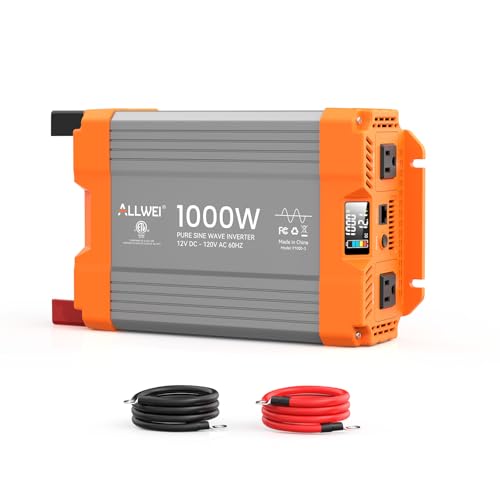
【Powerful DC-AC Converter - Effortless Start】: ALLWEI 1000 watt inverter delivers continuous DC 12V to 110V/120V AC power, 2000W peak surge handles smooth load start-ups effortlessly, is suitable for inductive and capacitive loads—no more startup power struggles. Pure sine wave with maximum conversion efficiency >91%, this power inverters for vehicles minimizes conversion loss while powering RVs, trucks, off grid electrical appliance.This inverter has got ETL UL458 certificate
Everyday Uses: Where Power Inverters Show Up
Power inverters appear in your daily life in various practical ways. In your car, they let you plug in a laptop or game console by converting the car’s DC battery power into standard AC outlets. When camping, they provide electricity for lights and charge your phone far from any wall socket. During an outage, an inverter can turn your home battery bank into an emergency power source, keeping your fridge, lights, and essential devices running. They also play a key role in battery management by making stored DC energy usable for regular AC appliances. In solar energy systems, inverters are essential for renewable integration, converting the DC output from panels into AC power for household use. At home or in the office, they enable your TV, Wi-Fi router, and power tools to operate seamlessly from a DC source, ensuring AC power is available wherever you need it.
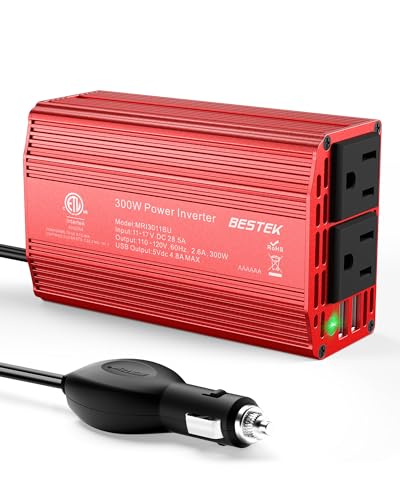
BESTEK Advantage Upgraded: Bestek is power inverter patents owner, America's leading power inverter brand. Our inverter tech upgraded to 11-17V compatible with Tesla. It provides 300 Watts continuous DC to AC power and 700 Watts instantaneous power, featuring 2 AC outlets and 2 USB ports

【Pro Chaser Power Inverter Basics】: This inverter provides a steady 400W of DC to AC power with a peak output of 800W. Equipped with dual 110V AC sockets and two high-speed 3.1A USB ports, it's perfect for powering your devices on the go.

〖Premium150W Power Inverter〗Car Power Inverter Provides 150 watts continuous DC to AC power and 300 watts of peak power. Great for charging string lights, laptop, breast pump, CPAP machine, nebulizer, game console, TV, DVD players, lights, iPad, and other electronic devices.
Inverter Efficiency: What 90% Really Means
A 90 percent efficiency rating means you lose 10 percent of your input power as heat. For every 100 watts you supply to the inverter, only 90 watts are converted into usable AC power. The missing 10 watts represent energy lost during the conversion process, which the inverter internally burns off as heat instead of delivering to your devices.
In real-world situations, this efficiency doesn’t stay constant. It tends to drop at lighter loads because fixed overhead expenses, such as internal circuitry, take up a larger share of the total power. The inverter performs closest to its rated efficiency near its optimal load, not during minimal draws, so expect slight variations depending on your power usage.
Higher efficiency directly extends your battery runtime. For example, if you draw 500 watts, but your inverter consumes an additional 50 watts due to losses, you’re effectively using 550 watts of battery power every hour. Over time, this inefficiency results in shorter operating periods and increased heat that needs to be managed.

【POWERFUL DC to AC CONVERTER】: This solar inverter delivers 2000W of continuous battery DC 12V to AC 110V 120V power and up to 4000W of peak surge power when the load is started. The 12V inverter has a conversion efficiency of greater than 93% during normal working and low no-load losses

Unique Glass Cover Design: Tempered glass upper cover with big 6.25 inch LCD display and touchable buttons, cool look with high transparency, more clear to see real-time data of your inverter

【PURE SINE WAVE INVERTER】: The power inverter output waveform is consistent with the AC waveform of the utility grid and is suitable for inductive and capacitive loads. It extends the service life of the equipment and reduces the fault rate. Can be used with electrical equipment such as televisions, home theaters and other sensitive loads for a long time
How to Choose the Right Power Inverter
Understanding inverter efficiency is crucial because it directly affects how much power you get from your system. To select the right unit, start by calculating your load. Add up the running watts for all appliances you’ll operate at the same time, then factor in the largest startup surge. Include an additional 10% to 20% headroom to account for potential increases in power needs. Be careful not to confuse peak wattage with continuous output—your inverter should be rated for the continuous power your appliances require. Match the continuous and surge ratings carefully, especially for motors, which can draw two to five times their running watts during startup. When positioning the inverter, avoid placing it near a generator or any device where inadequate ventilation could cause overheating and noise issues. Furthermore, treat the inverter’s fuel source with the same care as safe gas can use to prevent fire hazards during refueling. For example, a 400-watt inverter can run a small laptop or LED TV, but its starting-watts versus running-watts limits mean you must verify that the surge rating covers any motor-driven appliance before plugging it in.
Choose a pure sine wave inverter if you plan to power sensitive electronics like computers or medical devices, as these produce cleaner power. Modified sine wave units are generally less expensive and can run simpler tools, but they may cause performance issues or create noise with more delicate devices. Always check battery compatibility; 12V systems are suitable for small setups, whereas 24V or 48V systems support larger loads and reduce cable thickness, improving efficiency and safety.
Finally, consider noise levels. Some inverters run fans constantly, which can be noisy, while others cycle the fan on and off depending on load and temperature. Verify the available installation space, ensure proper ventilation, and review fuse and safety requirements. The best inverter aligns efficiency, waveform type, and physical fit with your specific power needs.

BESTEK 300W Pure Sine Inverter (Patent Number US D818,853 S): Designed for your devices that require careful protection, provide 300W continuous DC to AC power and 700W of peak power featuring 2 AC outlets and 2 USB charging ports, great for Christmas gift, charging string lights, laptop, speakers, camera, nebulizer, game console, kindle, iPad and other

【𝟑𝟎𝟎𝟎 𝐖𝐚𝐭𝐭 𝐈𝐧𝐯𝐞𝐫𝐭𝐞𝐫】--- This pure sine wave inverter can provide 3000W continuous clean DC to AC power (6000W surge) with >91% efficiency, which strongly and effectively reduces conversion loss and protecting sensitive electronics (Microwave Oven, Laptops, CPAPs, LEDs) from damage. Handles heavy startups (Coffee Machine, Window AC, Power Tools) effortlessly. For RV, Home, Solar, Emergencies.
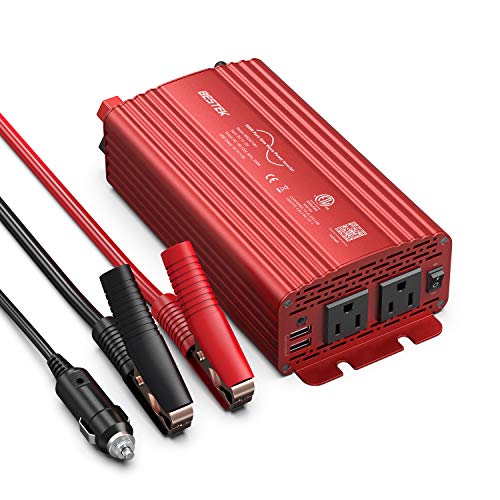
BESTEK 500W Pure Sine Wave Car Inverter:Its output waveform is same as the AC power waveform of mains power grid which delivers a smoothly-varying sine wave for sensitive electronics provided by the electric utility.Perfects for off-grid system,Lower THD,Less wear,Strong inductive Loads Capability.It has little interference with radios, communication and precision equipment.It's also recommended by most cordless tool manufacturer that a pure sine wave inverter is used to ensure long battery life